
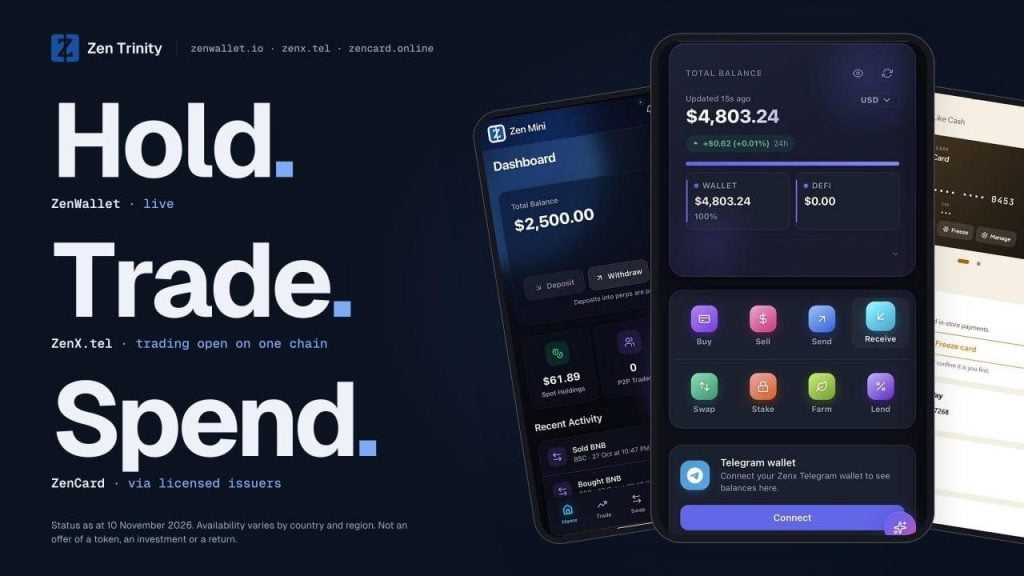
VANCOUVER, British Columbia, 11th November 2026, People paid in USDT, holding it or trading it now have a published status for each of Zen’s three retail products. ZenWallet, a self-custody wallet with no seed phrase, is live at app.zenwallet.io and on Telegram at @zenwalletbot. ZenCard, a Visa card in virtual and physical form, is issued by licensed financial institutions in the countries they serve. ZenX.tel, the Zen Telegram Mini Exchange, has opened trading on BNB Smart Chain at @zenexchangebot, in an early release gated by region and identity. Zen calls the three its Trinity; this release states where each one stands.
Why does it matter? A stablecoin balance is only useful if it can be held without a seed phrase to lose, spent without a manual cashout first, and bought or sold against the money a person is paid in.
ZenWallet, live. The signing key is split into three shares (device, ZenWallet server, backup recovery service) under 2-of-3 threshold signing, so no single party, Otaro Pay Ltd. included, can move funds alone. On Ethereum, Polygon and BNB Chain only, the network fee is quoted in USDT before signing and settled by the wallet. Sending and receiving carry no ZenWallet fee. Daily spending profiles cap at USD 5,000 or USD 50,000, with a second factor above USD 1,000 and USD 5,000 respectively; recovery runs through named guardians or trusted contacts plus a passkey or hardware key. Cashout to a bank account is built in for countries where the route is live, as at 10 November 2026.
ZenCard, issued by licensed institutions. The card settles in local currency at the till and is funded from Bitcoin, Ethereum and USDT balances. The holder sets daily and monthly caps and merchant-category restrictions. Fees, limits, rates and eligibility are set by the issuing institution and disclosed in its terms before application. Otaro Pay Ltd. operates the ZenCard website and does not itself issue cards. Visa acceptance in more than 100 countries is not the same as eligibility to be issued a card: availability varies by country.
ZenX.tel, trading open in early release. On BNB Smart Chain, identity-verified users trade USDT peer to peer: the seller’s USDT sits in on-chain escrow until the seller confirms payment or an arbitrator rules, and local currency moves between the two people, outside Zen’s systems. Spot and swap are in beta. One perpetual market, ETH, is tradeable; perpetual contracts involve leverage and can cause rapid loss, including full loss of margin, and the margin sits in the exchange’s contract with Zen’s pool as counterparty. Users sign every fund-moving action in their own wallet; the app never holds a private key. Platform fees under the 8 November 2026 schedule: P2P buyers none; sellers none for 90 days from launch, then 0.25 percent; spot and swap 0.25 percent on the USDT leg; perpetuals quoted per order; deposits none; withdrawals network cost only.
Each statement rests on a published page: zenwallet.io/security and zenwallet.io/press, zencard.online, and zenx.tel, which labels each component live, beta, in review or planned.
Three questions to ask any multi-product crypto launch, including this one. Who holds the key, and can any one party move the funds alone? Who issues the card, under whose licence, and in which countries? What is live today, what is in beta or planned, and where is that written down?
“Three products announced together are three claims, not one,” said Poonam Jaiprakash, Group Director. “We would rather tell a reader the exchange is in early access and the card depends on an issuer in their country than let them find out after they have moved money. The wallet is called live because it is finished; the other two will be called live on the day they are.”
“The hardest work in the Trinity is the work nobody sees,” said Arjun NK, Tech Director, Zen Atlas Group. “A lost phone, a disputed trade, a transaction that does not match its quote. Our engineers put their hours there, and what is not finished still says beta.”
Where it does not apply. No route between the products is claimed: funding a ZenCard from ZenWallet, or signing ZenX.tel trades with it, will be described only once that exact route is verified. ZenX.tel is an early release on one chain; TON, an independent audit, a bug bounty and proof of reserves are labelled planned, and its blocked-country list is not published. Because ZenWallet is self-custody, nobody, the company included, can reverse a transaction. This announcement describes what three products do and cost; it is not an offer of a token, an investment or a return, nor a recommendation to trade.
To check availability: zenwallet.io/get-started, zencard.online and zenx.tel/availability
About Zen
Zen is the group behind ZenWallet, ZenPays and Atlas Rails. Digital money infrastructure: wallet, card, payments, settlement, custody. Built properly. ZenWallet and the ZenCard website are operated by OTARO PAY LTD., incorporated in British Columbia, Canada (BC1417547), registered with FINTRAC as a money services business (M23150730) and with the Bank of Canada as a payment service provider under the Retail Payment Activities Act (RPS0014977). Neither regulator reviews, approves or endorses the products. Otaro Pay Ltd. is not a bank; balances are not deposits and are not insured. ZenX.tel’s operating entity is published on zenx.tel once legal confirmation completes.
Disclaimer: The views, suggestions, and opinions expressed here are the sole responsibility of the experts. No Economics Bot journalist was involved in the writing and production of this article.